In your day-to-day practice, choosing the right vial is an important consideration in laboratory, pharmaceutical, and research settings. This is a big part of maintaining an efficient workflow and supporting accuracy and precision, which are crucial when working with sensitive formulations, automated equipment, or specialized storage requirements.
Selecting the correct container for the application and the material being stored helps minimize contamination risks, avoid slowing production, and ensure it matches your facility's equipment. Two of the most commonly used vial types are open molded vials and tubular R vials, including standardized formats such as 6R and 10R.
We’re going to take a look at the advantages and key differences between standard open vials and ISO R vials depending on your needs.
Why Vial Selection Matters
Different applications require different vial dimensions, capacities, and closure systems. A vial used to hold a laboratory reagent may have different requirements from one intended for pharmaceutical preparations or injectable products.
Depending on the contents, the glass type, color, capacity, and closure system are important considerations. For example, Type I borosilicate glass offers high hydrolytic resistance and resistance to thermal shock. While standard open vials offer flexibility across a range of sizes and configurations, R vials are manufactured to standardized tubular glass formats in accordance with ISO dimensions and are commonly used in pharmaceutical applications where vial dimensions and consistency are required.
At Med Lab Supply, we offer a range of glass vials, including open clear and amber vials, tubular and molded designs, and sterile and non-sterile options. Our selection includes glass vials and components for laboratory, pharmaceutical, research, and technical applications.
Clear vs. Amber Glass Vials
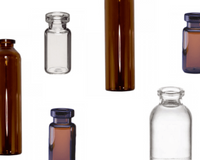
Both our molded and tubular glass vials are available in clear and amber colored glass options, depending on your application requirements.
Clear vials offer visibility and allow easy monitoring of vial contents. These are beneficial when working with light-stable materials, dealing with colored compounds, and for visual inspections.
Amber-colored glass vials help shield contents from harmful UV and visible light. This offers protection when storing light-sensitive compounds, pharmaceuticals, and solutions that would otherwise degrade with sunlight.
Standard Open Vials (Molded)
Standard open vials are supplied unsealed and uncapped, allowing for stoppers, seals, or other closure components depending on your needs. Our vials are available in a range of sizes and configurations for laboratory and pharmaceutical applications.
These standard vials are commonly available as molded glass vials, which are manufactured using a mold and typically have thicker walls. This construction provides durability for physical handling and storage. They are manufactured from borosilicate glass, which offers enhanced durability and chemical and heat resistance.
These vials are used for a range of applications, including:
-
Laboratory samples and reagents
-
Pharmaceutical preparations
-
Diagnostic materials
-
Chemical storage
-
Chromatography samples
-
Freeze-drying (lyophilization)
-
Research and sample storage
Our open vials can be paired with compatible stoppers and seals based on the application requirements. Additionally, our molded vials may have fine silica dust present from the manufacturing process and should be washed before use.
For all open, non-sterile vials, appropriate cleaning and sterilization are required to hold sterile specimens according to the specific requirements of your lab, clinic, and research setting. There are also ready-to-use sterile open vial options available to meet your needs.
R Vials (Tubular)
R vials are standardized tubular glass vials that are specified under ISO 8362-1. This standard specifies the form, dimensions, capacities, materials, and performance requirements. At Med Lab, our tubular vials are manufactured from Type I borosilicate glass tubing and are suitable for laboratory samples, reagents, pharmaceuticals, chemicals, and chromatography applications.
These vials are commonly used for applications such as:
-
Pharmaceutical preparations
-
Standardized filling and packaging processes
-
Smaller fill volumes
-
Freeze-drying (lyophilization)
-
Autoclaving
Type I borosilicate glass tubing can provide a lighter-weight alternative to molded glass vials. It’s known for its strength, durability, and high resistance to chemical and thermal stress. The consistent tubular construction provides uniform wall characteristics, and this can be beneficial for lyophilization processes, pharmaceutical preparations, and smaller volumes.
R vials are available in a range of standardized formats including: 2R, 3R, 4R, 6R, 8R, 10R, 15R, 20R, 25R, and 30R. This number identifies the nominal filling volume, while the brimful capacity is higher. For example:
-
6R: 6mL nominal capacity and approximately 10mL brimful capacity
-
10R: 10 mL nominal capacity and approximately 13.5mL brimful capacity
Having this standardized sizing across a range of capacities makes it easier to select a vial based on the required fill volume while maintaining consistency across various stages of handling, filling, and packaging. This supports efficient filling and stoppering, including high-speed manufacturing processes, while providing additional headspace for product expansion, pressure changes, mixing, and withdrawals.
The Differences Between Standard Open Vials vs. R Vials
Between standard open vials and R vials, they primarily differ in their construction, dimensions, and intended applications. Molded and tubular construction can also affect characteristics such as wall thickness, weight, and handling.
When choosing between the two formats, a standard molded open vial can offer flexibility with various sizes and configurations. R vials offer standardized dimensions for consistent filling, stoppering, and crimping, which makes them beneficial where repeatable handling and equipment compatibility are important.
Some of the key differences are highlighted in the table below:
| Feature | Standard Open Vials | R Vials (e.g., 6R, 10R) |
|---|---|---|
| Availability | Available in various sizes and configurations | Manufactured to standardized R dimensions |
| Format | Typically molded glass | Standardized tubular glass |
| Wall Characteristics | Typically thicker glass walls | Consistent tubular wall characteristics |
| Equipment Compatibility | Suitable for manual fill, benchtop, and standard research | Typically well suited to processes where consistent vial dimensions are important |
| Closure | Compatible with appropriate stoppers and seals based on vial format | Compatible with standardized stoppers and crimp finishes for specific vial format |
| Main Advantage | Flexibility for different laboratory applications | Consistent dimensions for standardized processes |
| Applications | Samples, reagents, chemicals, pharmaceuticals, chromatography, freeze-drying | Pharmaceutical production and other applications where standardized vial dimensions are important. |
We also offer a variety of vial stoppers and seals to meet your application needs, including standard rubber stoppers, lyophilization stoppers, standard aluminum, flip-top, and dual-tone flip-top seals, in a range of colors for easy identification.
Choosing the Right Vial with Med Lab Supply
Between molded and tubular vials, the right choice depends on your intended application, required capacity, dimensions, closure system, handling process, and equipment compatibility. Standard open vials provide flexibility across a range of sizes, constructions, and glass colors, while R vials offer standardized tubular formats for applications where consistent dimensions are important.
At Med Lab Supply, we provide a wide selection of molded and tubular glass vials, along with compatible stoppers and seals, to help support your laboratory, pharmaceutical, research, and technical applications. We proudly deliver high-quality supplies designed to help maintain efficiency and sample integrity in your work.